Make one useful decision
Household Supplies Inventory: When to Restock and How Much to Keep
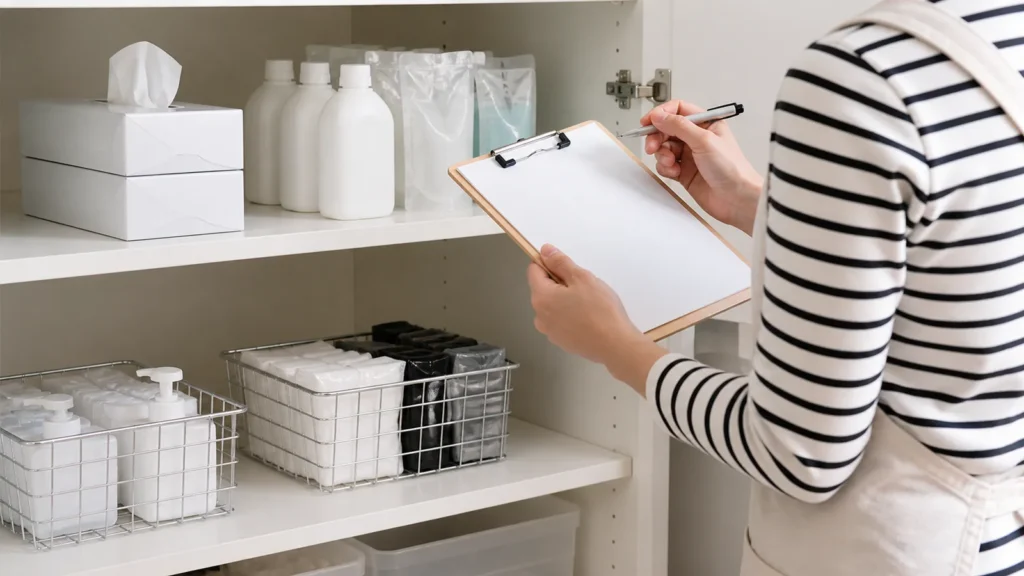
A household inventory is useful when it tells you when to buy and when to stop. You do not need to count everything you own or install an app to begin.
This guide covers everyday non-food supplies such as paper products and household consumables. Food storage, medicines, and emergency reserves need their own checks and are outside this routine stock list.
Start with supplies you run out of or buy twice
Choose items that recently caused a problem: you ran out, could not substitute something else, or two people bought the same replacement. Leave occasional purchases off the weekly list. Check them when you actually need to buy them.
First look for duplicates in different cupboards. Choose one safe storage location for spare stock where practical. Do not move a product away from the storage conditions on its label just to keep everything together.
Set both a restock trigger and a storage limit
A restock trigger is the point at which you add an item to the shopping list. It depends on normal use, the next realistic shopping date, delivery time, and any margin you choose. The storage limit is the most you can keep in the assigned space under suitable conditions.
| Write down | Why it matters | Example |
|---|---|---|
| Exact item or size | A replacement must fit its purpose | The size of bag that fits your bin |
| Storage location | People know where to check | Assigned kitchen drawer |
| Restock trigger | You know when to consider buying | Not enough until the next shopping trip |
| Maximum total | A promotion does not decide your stock level | Opened and spare stock together must fit the assigned space |
“Always keep one spare” can work for some products, but it is not a universal rule. A slow-used refill and a daily-used paper product need different checks. Try one rule and adjust it after the next purchase.
Work through one count before buying a multipack
Here is an invented example, not a recommended stock level. A household uses one bin liner per day, has eight left, and expects to shop again in fourteen days. At that rate it needs six more liners to cover the gap, before any extra margin the household decides to allow.
A ten-pack would bring the total to eighteen. A twenty-pack would bring it to twenty-eight. If its chosen storage limit is twenty, the larger pack does not fit that rule even if its unit price is lower. Reconsider the pack size, purchase timing, or storage plan rather than ignoring the limit.
Actual use can change with visitors or other circumstances. Count the current stock and check the next realistic shopping opportunity each time; the example is not an automatic reorder instruction.
Keep a standing inventory and a trip list separate
The standing list holds your rules. The shopping list holds what someone is buying this time. Copy only items that need action. A stock rule left permanently on the shopping list can look like an instruction to buy on every trip.
- Check the assigned storage location.
- If the trigger is reached, add the item once to the shared shopping list.
- Before leaving, identify who is buying it this time.
- Mark it bought when purchased, so another shopper does not buy it again.
- Put it in the assigned location and check the total against the limit.
Record specifications that matter, such as a compatible refill or bag size. Agree whether substitutions are acceptable or require a message first.
Choose a tool your shoppers can actually check
A paper list beside the cupboard works when the same person checks and shops. If several people shop separately, use a shared note they can access away from home. For a paper-only routine, choose one shopper for each trip and hand over the checked list.
Subscriptions still need a check before the next shipment, especially when use varies. Adding another tool cannot fix an unclear rule about who marks a purchase complete.
One-item inventory card
Item and specification: ____________________
Stored at: ____________________
Count checked on: ____________________
Add to list when: ____________________
Maximum total in this space: ____________________
Buying this time / buyer: ____________________
Keep the original product information
Follow labels for storage, refilling, and compatible containers. Do not mix different cleaning products or transfer them to an unlabelled container for a matching appearance. Keep them out of children's reach as directed. A tidy shelf is useful only if the products can still be identified and used correctly.
If a family member helps count supplies, define the task and its finish condition together. See chores for middle schoolers and a simple agreement. If spare stock keeps occupying the cooking area, use the small kitchen counter checklist.