Make one useful decision
Small Kitchen Counter Space: What to Keep, Move, and Prepare in Stages
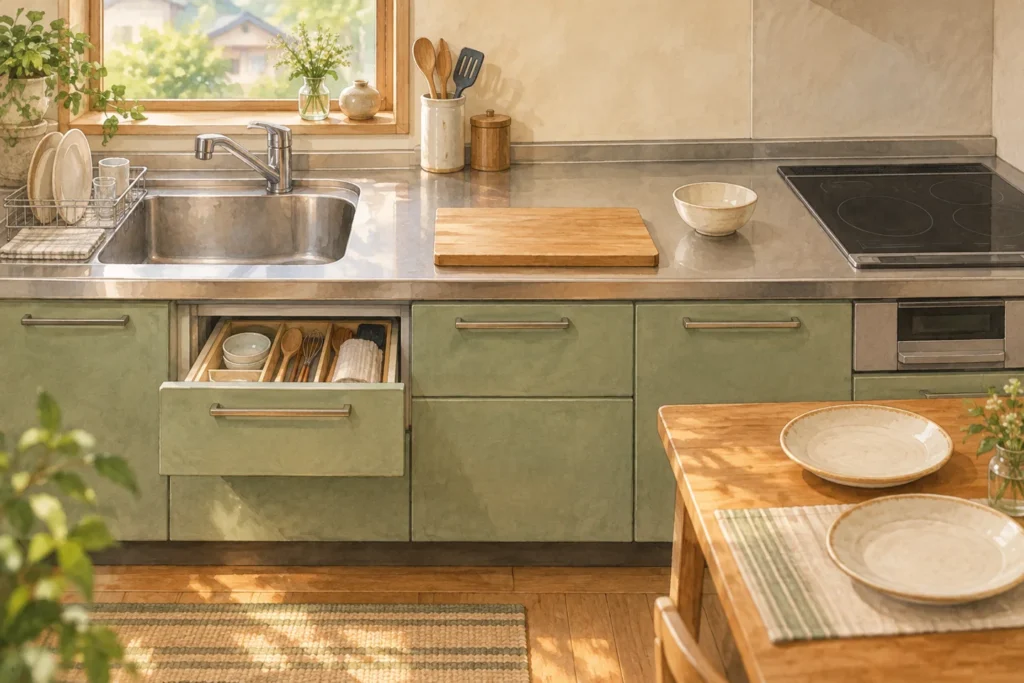
If you move jars before putting down a cutting board, then move plates to make room for ingredients, the problem may be the sequence as much as the size of the kitchen.
Start by finding a stable, fully supported place for your cutting board and a place for prepared ingredients or the next plate. Where both will not fit together, use the same clear area at different stages. Try one meal before buying another rack.
Find the stage that gets blocked
- Before cutting: there is no clear, level space for the board. Review things that permanently occupy the counter.
- After cutting: ingredients cover the board and there is nowhere for a bowl. Decide their temporary destination before starting.
- At serving time: there is no place for plates. Change when you bring the plates out or where finished plates go.
Choose the most troublesome stage first. You do not have to reorganize every cupboard to test whether one clear route through the meal helps.
Decide what stays and what moves
“I use it every day” does not always mean “it needs to stay here during cooking.” Ask whether the item is used at this spot, whether you can put it away conveniently, and whether it needs a place during this particular stage.
| Item | First thing to try |
|---|---|
| Cutting board and tools in use | Give them a stable working area before putting anything else out |
| Unopened supplies and spare packets | Return them to suitable storage; bring out only what is needed |
| Tea or coffee supplies | Try an accessible cupboard if they are used at a different time |
| Dry dishes in the draining area | Put them away before starting the next meal |
| Kettle, rice cooker, or other appliance | Check its instructions for heat, steam, ventilation, electricity, and placement before moving it |
| Mail, keys, and empty shopping bags | Choose a receiving place outside the food preparation area |
Moving things onto another surface only works if that surface has an agreed purpose. Choose a return location, not a new permanent pile. If spare supplies are the problem, the household inventory guide helps set a storage limit.
Use one area in three stages
1. Before preparation: place the board first
Put dry dishes away, then position the board. Bring out the tools and ingredients required for the current stage rather than laying out everything for the whole meal. Take refrigerated ingredients out as needed for preparation; do not leave them out simply to make a display.
As packaging becomes unnecessary, move it to the appropriate waste or recycling place. Otherwise it occupies the spot needed for the prepared food.
2. While preparing: give cut ingredients a destination
Set a suitable bowl or container in a place you can reach without balancing it. Move prepared ingredients there when appropriate so the board can be used for the next step. Keep the washing and separation practices needed for the foods you handle; limited space is not a reason to skip them.
Do not balance a board across an unsupported gap or improvise a work surface on an open drawer. Keep the cooking surface clear even when switched off rather than counting it as extra counter space.
3. Before serving: change the role of the clear area
When preparation is finished, put unnecessary tools away and clean the area before bringing plates into it. If several plates will not fit, try plating one at a time and moving completed plates to a ready dining table.
Plan where hot cookware can go safely. A dining table can hold clean plates, but it is not automatically a good place to carry hot pans. Avoid arrangements that block a walkway or require awkward reaching.
Two common bottlenecks
The dish rack occupies almost everything
Check for dry dishes that could already be put away. Then check whether the empty rack can be stored and dried appropriately between uses. If wet dishes constantly fill it, buying a smaller rack may simply move the problem elsewhere; review when dishes are put away and how much is washed at once.
Serving plates arrive too early
Prepare clean plates on a ready dining table if that suits your home, then bring over only the one being filled. Otherwise, finish the cutting stage before bringing the plates out. The aim is to avoid two stages competing for the same surface.
The one-meal workspace test
The stage that still gets blocked: ____________________
The item without a home: ____________________
One change for next time: ____________________
Buy only for the gap you can name
If the test works, you may not need anything new. If it fails, identify what lacked a place and at what stage. Before buying storage, measure the full footprint, openings, reachable position, and space needed for cleaning or putting it away. Check installation instructions and appliance clearances rather than guessing.
If an item returns to the counter every day, check whether its storage is too far away, blocked by other things, or unknown to another family member. Adjust one return location before reorganizing the whole kitchen.
Reference: Nitori's kitchen storage guide (Japanese), checked October 20, 2026. The workspace examples here are illustrative arrangements, not a report of a household trial.