Make one useful decision
How Many Paper Bags Should You Keep? A Practical Storage Limit
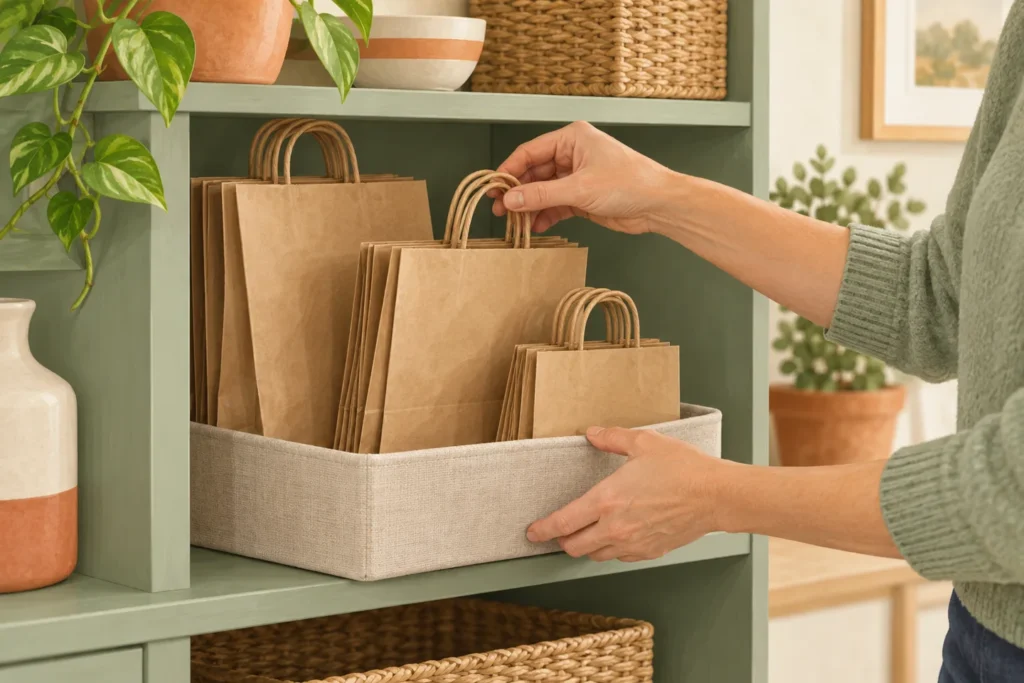
How many paper bags should you keep? Start with the sizes you actually use, then set a limit that fits one storage spot without cramming. A fixed number for every household is less useful than knowing what the next bag will carry.
This guide covers spare paper shopping and gift bags. If a bag already holds documents, check the contents before sorting the bag. For a manageable starting point, use the one-spot decluttering guide.
Check condition, purpose, and fit—in that order
Look at the base, folds, and handle attachments. Do not load a damaged bag to test whether it will hold. Size or thick-looking paper alone does not establish a safe carrying weight.
| What you have | Decision to make | Next action |
|---|---|---|
| Torn handles, a weakened base, dampness, or stains | Do not keep it as a carrying spare | Check your local disposal or collection rules for its material and condition |
| A specific item to give or carry | Keep a candidate that fits the item's width, height, and depth | Note the purpose and make the bag easy to reach |
| Several bags of the same size | Compare simultaneous needs and upcoming plans | Remove damaged or awkward candidates first |
| Large bags without an identified use | A larger bag is not always a practical substitute for a small one | Check whether anyone sharing the home needs it |
| A bag valued for its design or a memory | It can be a keepsake rather than a working spare | Give it a separate, deliberate collection space |
Still usable does not always mean useful in your household. Equally, not using something recently is not permission to discard another person's property. Check shared belongings with their owner.
Choose a provisional quantity from actual uses
Do not automatically keep equal numbers of small, medium, and large bags. Write the jobs first: handing over a small item, carrying documents, or another use that matters to you. Choose bags that fit those jobs, then decide on any spare allowance yourself.
Here is an illustrative example, not a recommended number for everyone or a measured household trial:
- You will give small items to two people separately next weekend: reserve two suitable bags.
- You sometimes carry documents and can reuse the same bag: choose one suitable bag and one spare.
- You have several large clothing-store bags with no planned use: check with anyone who shares them before deciding what to keep.
That creates four identified candidates: two for the handovers and two for documents. If the bags you own do not fit, do not fill the allowance just to reach four. Different plans can reasonably produce a different total.
Store bags so one can come out without emptying the rest
- Choose one home for working spares. Use an existing box or part of a shelf. Avoid spreading bags through several gaps around the home.
- Flatten along the original folds. Tuck handles neatly so they do not catch. Avoid folding so tightly that the bag becomes awkward to use.
- Keep useful sizes visible. If a deep box hides smaller bags, put them in a thin divider at the front. Test what you already have before buying an organizer.
- Set the limit by access, not maximum capacity. If every selection requires pulling the whole stack out, reduce the quantity or change the arrangement.
One large bag can be a storage container, but nesting similar bags several layers deep can hide their sizes. Test whether you can identify and remove a single bag easily.
When a new bag arrives, compare its purpose before adding it
Compare it with bags kept for the same job. If it fits better, replace a less useful candidate. If the current selection meets your needs, you may decide not to add it. Empty storage space is not a reason to fill the container.
If you later need a size you did not keep, note the missing job. Adjust the mix rather than increasing every size. The household inventory guide applies a related approach to supplies: match a useful quantity to the available storage space.
Check local rules before recycling or disposal
A paper bag is not automatically suitable for every paper-recycling collection. Check the local collector's instructions for coatings, contamination, and non-paper handles. Also check whether bags may be used to contain other recyclables; do not assume this is accepted.
As an example of why location matters, Mitaka City's guidance in Japan allows a paper bag to contain certain mixed paper but excludes water-resistant and dirty paper from that stream. This is a local Japanese example, not a rule for your area. Ask your own collection service about unfamiliar materials.
Four-line paper-bag storage plan
Copy these prompts onto paper or print the page. Checkboxes are temporary and are not saved when the page reloads.
- Jobs and sizes that fit: __________
- Planned uses plus my spare allowance: __________
- Storage location and an easy-access limit: __________
- What I will compare a new bag with / next review opportunity: __________
If deciding about a bag leads to a much larger sorting project, stop at the boundary you chose. Return to the small-area plan and restart note before taking out more things.
Reference: SOMPO Park's paper-bag storage column (Japanese) discusses limiting quantity and storage space. The decision table, example quantities, and worksheet here are AtodeRead's practical suggestions. Reviewed 2026-10-23.