Make one useful decision
What Goes in a Mesh Laundry Bag? Sorting and Sizing Guide
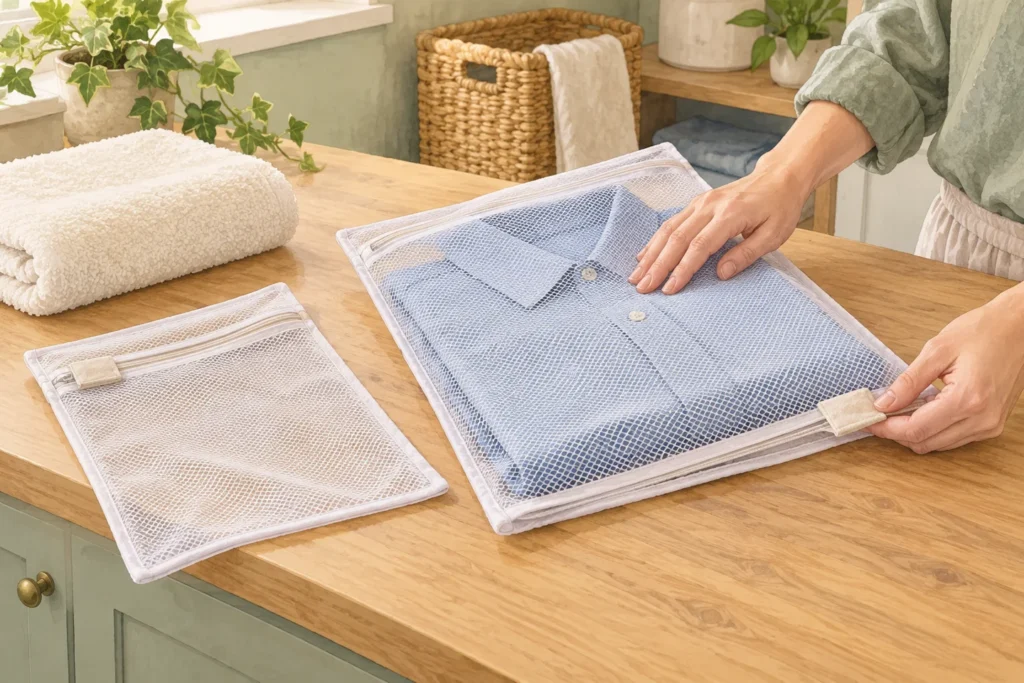
What belongs in a mesh laundry bag? Start with the garment's care instructions and your washer's manual. Then choose a bag for a specific purpose, such as reducing tangling or keeping suitable small items together. Putting everything into one large bag is not the same decision.
This guide helps you decide whether one garment needs a bag, which size fits, and whether it can share a wash with other items. Check the bags you already own before buying more.
Read three sets of instructions first
- The garment: check the permitted washing method, temperature, and any written directions. A bag does not turn a garment unsuitable for home washing into a machine-washable one.
- The washer: check the selected cycle, bag restrictions, and loading instructions. Bulky items or special cycles may have separate requirements.
- The bag: check its intended items, loading guidance, and drying compatibility. Its instructions must also fit the garment and machine.
Read written directions as well as symbols. Kao's Japanese care-label explanation, for example, includes additional wording about using a net or turning clothing inside out. Label formats and wording vary by market; use the directions supplied with your own garment rather than treating this Japanese example as a universal label key.
Choose by purpose, not just the garment name
| Item or purpose | What to check | What not to assume |
|---|---|---|
| Garment labeled for a laundry bag | Required preparation and a size suited to the folded garment | A bag permits a harsher cycle |
| Shirt prone to tangling or creasing | Whether home washing is allowed and a suitable fit | Several shirts in one large bag work the same way |
| Delicate fabric or decoration | Care limits and whether fine mesh or a purpose-made bag is suitable | Every knit or decorated item is machine washable |
| Small items you want to keep together | The bag's intended use and quantity, soil level, and matching wash requirements | Anything that lets the zip close is an acceptable load |
| Blankets or other bulky items | Machine compatibility and any specified bag and cycle | Fitting inside a large bag is sufficient |
Kao's laundry-bag guide distinguishes mesh and specialist bags by purpose. Treat examples as a starting point, not permission to disregard a particular garment's instructions.
Match the bag to the folded item
Prepare and fold the garment as directed, then compare it with the bag. Avoid forcing it into a bag that is too small or choosing one with excessive room for the garment to move. Use the loading directions for that particular bag.
For example, MUJI's Japanese guidance describes one garment per bag as a basic approach, a close fit for flat bags, and avoiding overfilling round bags used for small items. Do not apply one quantity rule to every design.
- Follow any directions for turning the garment inside out or other preparation.
- Fit the item without forcing it in or distorting its folded shape.
- If closing the bag requires stuffing, reconsider the quantity or size.
- Close the zip and tuck its pull into a protective cover if the bag has one. Check for torn mesh or damaged hardware.
If the right bag is unavailable, reconsider what to wash now. Do not solve the problem by ignoring your washer's restrictions and buying the largest bag.
Separate bags do not create separate wash conditions
Items in separate bags still share the washer's water, detergent, and cycle. A direction to wash separately, or a different required wash method, is not satisfied merely by using another mesh bag.
- Group compatible wash requirements first. Compare care directions with the machine and cycle.
- Then identify items that need bags. Protecting one garment and grouping small items are different purposes.
- Check the complete load. Dividing clothing into bags does not remove capacity or imbalance restrictions.
Hitachi's Japanese support guidance includes limits on bag loading and size when discussing imbalance. Those are manufacturer-specific instructions, not worldwide dimensions for every washer. Consult the manual for your actual model.
Example: a repeatable decision for one shirt
This fictional card illustrates the method; it is not a measured test of crease reduction or fabric protection:
Item: one everyday shirt
Checked: the care label allows home washing and requires a bag; the washer's relevant cycle and bag restrictions have also been checked
This wash: one shirt in a suitable flat bag, with zip and cover checked; other items selected for matching care requirements
After washing: dry according to the garment's instructions. Having used a bag does not establish tumble-dryer compatibility
A three-line garment card
Copy onto paper or into your usual notes, or print this page. Start with one garment you regularly hesitate over.
- Garment and written care directions: __________
- Bag, quantity, and preparation: __________
- Compatible load and cycle / drying destination: __________
Checkboxes are temporary and reset on reload. Recheck the instructions when you replace the garment, bag, or machine.
After washing, remove the clothing and use its permitted drying method. Dry and store the bag according to its instructions so that used and ready-to-use bags are easy to distinguish. The small-bathroom storage guide can help you choose a place that leaves the workspace clear. If other people share laundry tasks, the chore-chart guide helps define where each task ends.
Official information checked 2026-10-25. Garment, machine, and bag requirements vary. Linked Japanese brand guidance is illustrative; your product instructions take priority. The illustration is explanatory, not a test photograph or an actual care label.