Make one useful decision
Kids Folding and Putting Away Laundry: Agree on One Clear Task
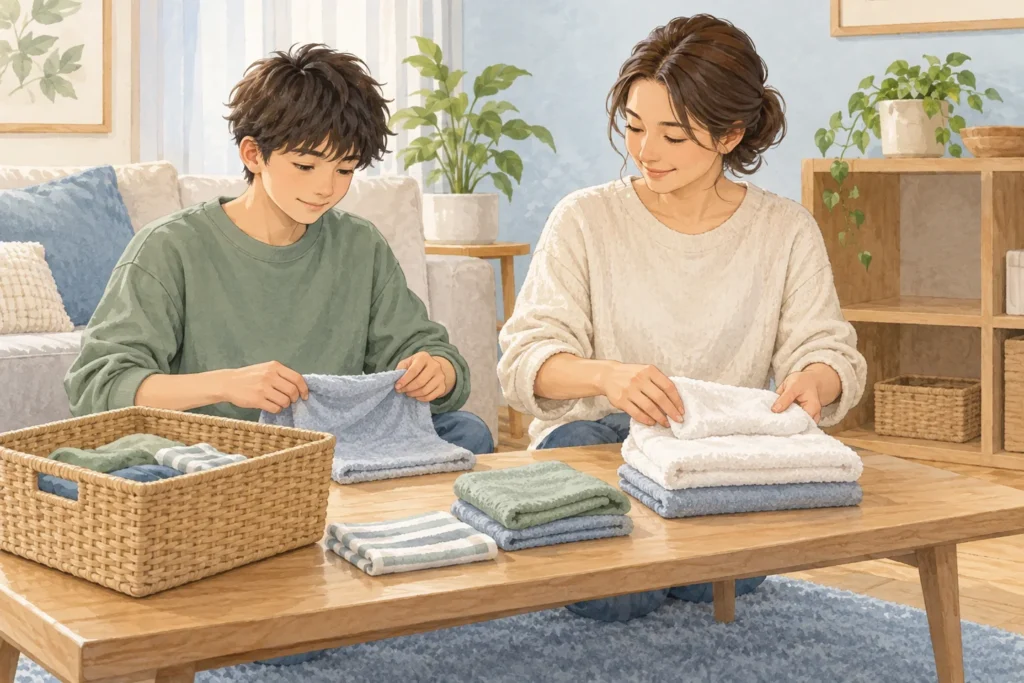
When a child helps fold and put away laundry, agree on whose items, which step, and what counts as finished. “Put the laundry away” can mean sorting, folding, carrying, or storing it. Those are separate tasks.
Start with a small scope the child agrees to, such as their own already-dry clothes. Age alone does not establish readiness: consider experience, reach, the items involved, and that day's commitments.
Choose one step instead of assigning all the laundry
| Possible task | Prepare first | Finish condition |
|---|---|---|
| Sort by owner | Provide dry items and a place for anything the child cannot identify | Known items are separated; uncertain items await a question |
| Fold towels | Try one together and check the width against the storage space | A folded group in an agreed place; specify if storage is included |
| Fold their own clothes | Set aside the agreed items, excluding anything needing special handling | Items remain recognizable and fit their destination |
| Put folded items away | Check reachable storage and available space | Items are back in the agreed place and the route is clear |
This is a discussion table, not an age-based milestone list. Sorting alone can be the agreed task. Identify who handles the remaining steps at the same time.
Kao's Japanese children's chore guide separates laundry activities and suggests starting folding practice with towels. This article focuses on organizing dry laundry; it does not bundle detergent handling or machine operation into the same assignment. The linked Japanese campaign is a reference for that example, not a requirement to join an activity or buy a product.
Try one item together, including its destination
- An adult prepares the items. Confirm they are dry and set aside only the agreed group. Damp items need further drying.
- Agree on a useful example. Fold one item together and check that it fits the storage space and can be retrieved. Appearance alone need not determine success.
- Let the child try. Ask which part is difficult. Simplify the folds or choose another item rather than increasing the load.
- Confirm where the task ends. Specify whether it ends at a folded pile or inside a drawer, and where the next person receives anything unfinished.
A sample item or a simple drawing can show the agreed shape. No new app or family photograph is needed. If checking dryness is also part of the task, teach that as another step.
Detergent, irons, dryers, high drying racks, and heavy baskets are not automatically included. An adult needs to assess supervision and product requirements separately. Do not ask a child to climb storage furniture to reach a shelf.
If clothing stays in the basket, find the stopping point
- The owner is unclear: begin with the child's own items and set a place for questions.
- The folding method is unclear: use one type of item and the same example.
- The drawer is full: check available space and folded width together; do not force the clothing in.
- Storage is out of reach: change the destination or return that step to an adult.
- The timing does not fit: ask about meals, schoolwork, activities, and rest before choosing another time or amount.
Describe where the task stopped rather than labeling the child as unwilling. Return to the agreed finish condition instead of requiring an adult's speed or exact appearance.
Change the scope on a busy day
School activities, exams, events, and health can change what is manageable. Agree whether to reduce the quantity, remove one step, or have an adult take over for that occasion. For example, the child might fold only their own shirts while an adult stores them.
Do not silently turn a change into extra work owed later. Note when to discuss the usual arrangement again. If responsibilities repeatedly displace sleep, learning, or rest, adults should reassess the household arrangement and available support rather than expecting the child to solve the pressure alone.
For other possible tasks, return to the practical chore list. “Middle school” and school schedules differ by country; use the child's actual routines and support needs. To identify work left for other family members, use the household chore-chart guide.
Example: return a small group of clothes to storage
This fictional agreement illustrates the format; it is not a household test or a promise of habit formation:
Items: the child's shirts and towels, checked dry and separated by an adult
Starting cue: check the agreed basket after dinner
Finished: fold to the sample width and return to the designated reachable storage
Uncertain items: leave in the question area and ask the adult
Unavailable day: reduce the amount or switch to an adult; do not add compensating work to the next assignment
One-load agreement card
Copy this onto paper or into your usual notes, or print the page. Avoid recording detailed family schedules unnecessarily.
- Today's items and amount: __________
- What the adult prepares first: __________
- The child's steps and finish condition: __________
- Question area and person to ask: __________
- Busy-day change and next discussion: __________
Checkboxes are temporary and reset on reload.
If the destination is the problem, the small-bathroom storage guide can help you separate ready-to-use items from laundry awaiting its next step. A usable return place may be more helpful than another chart.
Reference checked 2026-10-26. This is a household discussion method, not an age-based readiness rule or a guarantee of independence, faster chores, or lasting habits. The illustration is explanatory.